
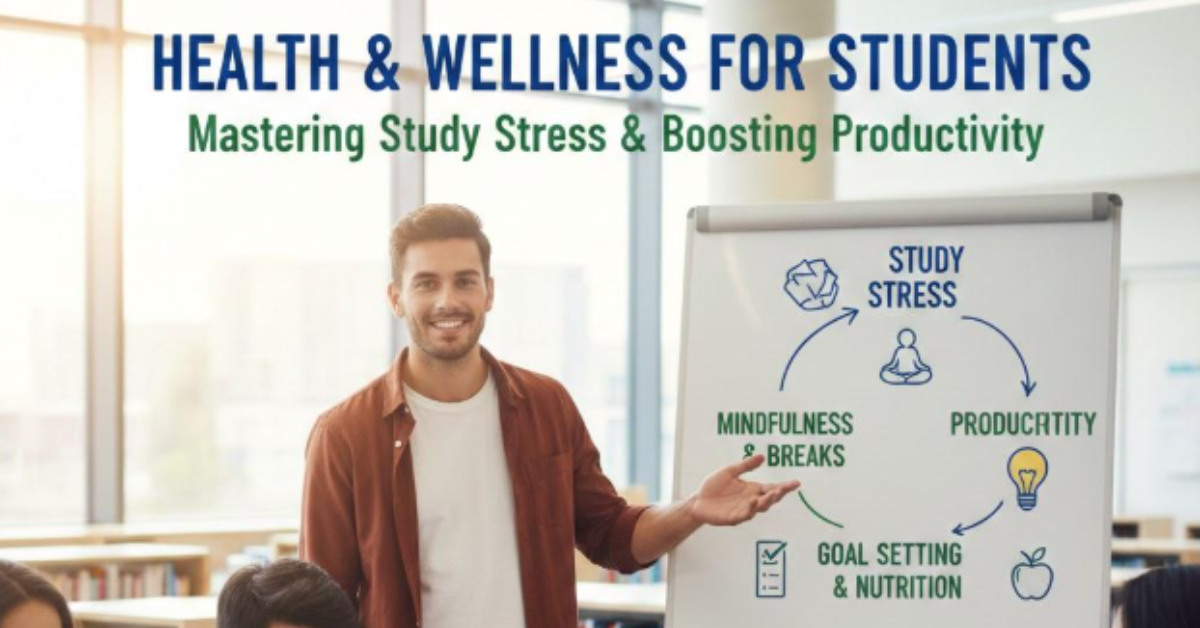
Health & Wellness for Students: Mastering Study Stress And Boosting Productivity
The transition from high school to higher education is often romanticized as a period of ultimate freedom. However, for most students in the USA, 2026 has introduced a high-stakes environment characterized by rigorous academic demands and the “always-on” nature of digital learning.
According to recent surveys, over 60% of college students report experiencing “overwhelming anxiety.” To truly excel, students must shift their perspective: wellness isn’t a reward for hard work; it is the foundation that makes hard work possible.
The “Stress-Productivity” Paradox
There is a common misconception that more stress equals more effort. In reality, the human brain follows the Yerkes-Dodson Law, which suggests that performance increases with mental arousal, but only up to a specific point.
When stress becomes chronic, it actively hinders your brain’s ability to retain information. For a student, “pulling an all-nighter” results in diminishing returns because your cognitive processing speed drops once you cross the peak of the curve.
Quick-Start Guide: Student Wellness Hacks
| Challenge | 2026 Productivity Solution | Key Benefit |
| Brain Fog | 50/10 Rule + Hydration | Maintains high-level focus |
| Sleep Issues | 30-minute Digital Sunset | Regulates Melatonin |
| Task Overwhelm | Eisenhower Matrix | Distinguishes urgent vs. important |
| Start-up Friction | The 5-Minute Rule | Breaks psychological resistance |
Strategic Support: Managing Cognitive Load
No successful professional works in a vacuum. In psychology, Cognitive Load Theory suggests that our working memory has a finite capacity. When the sheer volume of assignments exceeds your mental bandwidth, your ability to learn effectively shuts down.
The most successful students in the USA are those who know when to utilize their resources strategically. When the workload becomes mathematically impossible to manage alone—especially during finals week—seeking professional academic help is a smart move. Myassignmenthelp.com provides the necessary scaffolding, offering tutoring and assignment support that allows you to regain focus without compromising your mental health.
Physical Foundations for Focus
You cannot build a high-performance academic career on poor physical health. Your brain requires specific biological conditions to function:
- Sleep Hygiene: Sleep is when your brain encodes memory and clears out metabolic waste. For students, 7–9 hours is the gold standard.
- The 2026 Tip: Implement a “Digital Sunset”—stop using blue-light devices 30 minutes before bed to allow natural melatonin production.
- Nutritional Fuel: High-sugar snacks lead to glucose crashes and “brain fog.”
- The 2026 Tip: Focus on “brain foods” like walnuts, blueberries, and complex carbohydrates (oatmeal, brown rice) for steady energy.
Advanced Productivity: The “Deep Work” Method
- Being “busy” is not the same as being “productive.” To rank among the top students, you need to transition from reactive studying to proactive time management.
- The 50/10 Rule: Work intensely for 50 minutes, then take a 10-minute break away from all screens. This facilitates “Deep Work,” a state of distraction-free concentration where meaningful learning happens. When tackling complex projects, consulting an experienced assignment helper for structure or clarity can also reduce confusion and help you focus your deep work sessions more effectively.
- The Eisenhower Matrix: Stop using a simple “To-Do” list. Instead, categorize tasks by Urgency and Importance. This prevents you from spending your best energy on low-value tasks and allows you to prioritize assignments strategically.
Overcoming Procrastination and “Analysis Paralysis”
Procrastination is rarely about laziness; it is usually a coping mechanism for the anxiety associated with a task.
- The 5-Minute Rule: Commit to working for only five minutes. Usually, the hardest part is breaking the “static friction” of starting.
- The Zeigarnik Effect: This is a psychological phenomenon where our brains want to finish what we’ve started. Once you begin, the brain naturally pushes you toward completion.
Frequently Asked Questions
How do I know if I’m burnt out or just tired?
Fatigue goes away with rest. Burnout is characterized by emotional exhaustion, cynicism toward your studies, and a feeling of reduced accomplishment. If rest doesn’t help, it’s time to seek academic support.
Does “Box Breathing” actually work for exam anxiety?
Yes. Inhale for 4 seconds, hold for 4, exhale for 4, and hold for 4. This regulates your autonomic nervous system, moving you from “fight or flight” back into a logical state.
What is the best way to start a large research paper?
Break it down. Never put “Write History Paper” on your calendar. Instead, put “Find three primary sources.” Small wins build the momentum needed to overcome analysis paralysis.
About the Author
Michael Haydon is an academic success Strategist and Student Wellness Advocate. With a focus on “Cognitive Ergonomics,” Michael helps high school and university students across the USA optimize their mental output without sacrificing their well-being.
Also Read:Provascin: A Resilient Path Toward Everyday Wellness